
You’re moving from cattle or hay to wildlife
Your land already has an ag valuation. With a wildlife plan you keep the lower tax value, even if you graze less or stop for good.
Switching your Texas land from cattle or hay to wildlife use? Answer a few plain questions. We fill in the state’s plan form with a map of your land, then help you keep proof all year.
Free to try – pay only when your plan is ready.

Most of our landowners are in one of these three spots.
Your land already has an ag valuation. With a wildlife plan you keep the lower tax value, even if you graze less or stop for good.
The valuation doesn’t carry over by itself. You have to apply in your own name, usually by April 30 of the year after you buy.
Many counties want a yearly report with photos and receipts. We keep your proof in one place and fill in the report for you.
With an agricultural valuation, your county taxes the land on what it produces, not on what it would sell for. For most land that is a much lower number.
If the county takes the valuation away, your tax is based on the full market value from then on.
When land stops qualifying, the county can also charge back taxes for up to three years: the money you saved during that time.
Wildlife use lets you keep the valuation without running cattle or cutting hay. You need a written plan, and you need to do the work in it each year.
Four steps. You can do the first three in one sitting. These are real screens from the plan assistant.
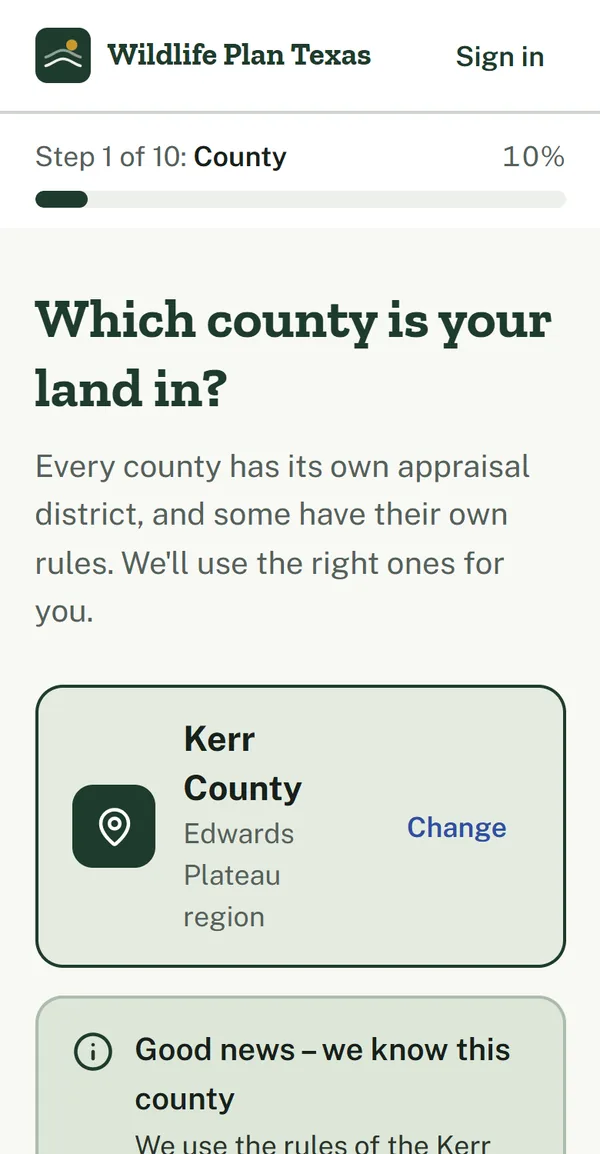
Your county, your acres and what grows there. We load your county’s rules as you go.
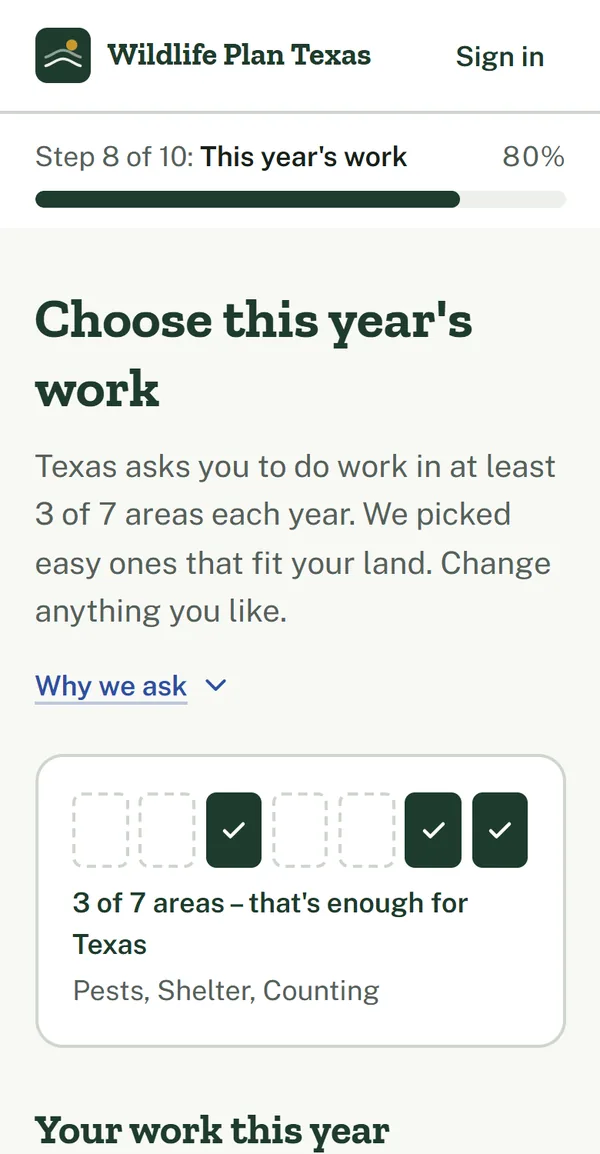
Texas asks for work in at least 3 of 7 areas. We suggest easy ones that fit your land, like nest boxes, brush piles or a bird count.
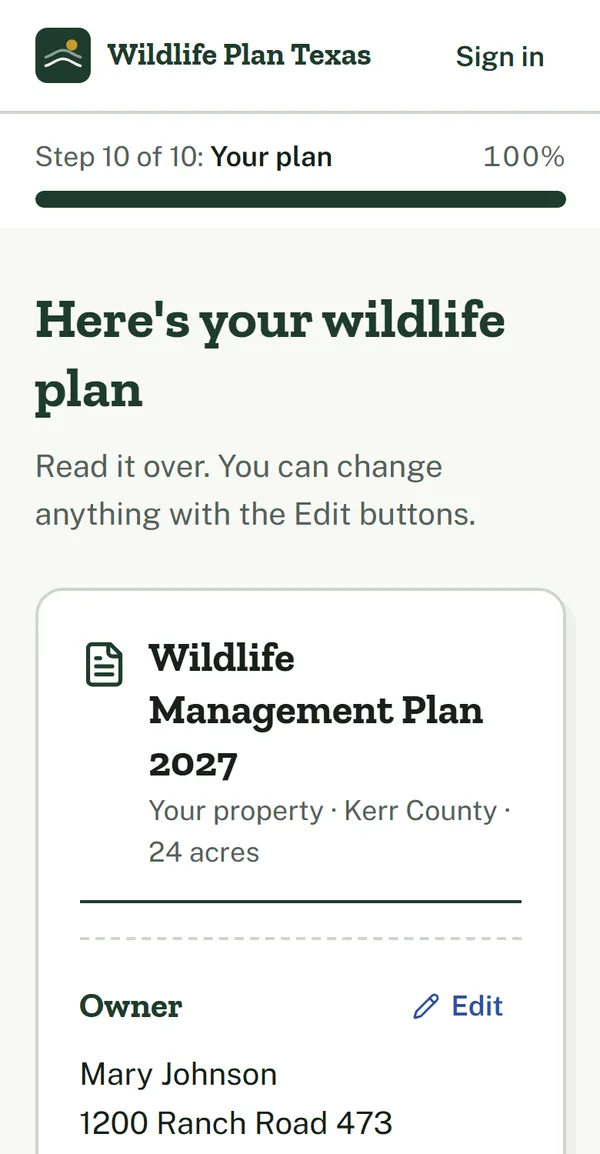
Download your plan with the map. Sign it and give it to your appraisal district with application 50-129, before May 1.
Snap photos and receipts on your phone. We email you before each task and deadline, and fill in your yearly report (PWD 888).
Wildlife Management Plan
PWD 885
The papers your appraisal district expects, on the forms it already uses.
Your wildlife management plan on the state form PWD 885, filled in and ready to sign
A map sketch of your property that marks where each practice happens
Your county’s rules: deadlines, whether a yearly report is required, and the minimum acreage after a split
A photo and receipt log with dates, so your proof is ready when the county asks
Email reminders before each deadline and each season’s work
Your yearly report on form PWD 888, built from your plan and your proof
No packages to compare. Try the assistant for free and pay when your plan is ready. Cancel any time in your account.
First year
$299
Your plan and map, the photo and receipt log, reminders and your first yearly report.
Each year after
$149
Yearly report, photo and receipt log, reminders and updates when your county changes its rules.
Money back if your county says no. If your appraisal district denies the application we helped you prepare, we refund your first-year payment in full. Send us the denial letter within 60 days.
So you know exactly what you are paying for.
We don’t sign or file anything for you, and we don’t act as your agent.
We don’t help with protests, appeals or hearings before the appraisal review board.
We are not a law firm and don’t give legal advice.
We can’t promise your county will approve. The decision is always theirs. That is why you get your money back if they say no.
We don’t do the work on your land. The plan only counts if you carry it out. We help you keep track.
We are not part of Texas Parks and Wildlife or the Texas Comptroller. We help only by email.
Wildlife use is a switch from an ag valuation you already have. Your land must have had 1-d-1 open-space valuation in the year before you switch. If it didn’t, wildlife use isn’t an option yet.
Usually not. A minimum only applies if your land is smaller than it was on January 1 of last year, for example after a split or a partial sale. Each county sets that minimum, often between 10 and 20 acres. We show you the number for your county.
Applications are due by April 30. Many appraisal districts still take late applications until mid-summer, with a penalty of 10% of that year’s tax savings.
That depends on your county. Some ask for a report with proof every year, others only when they request it. We tell you what your county needs and remind you in time.
It depends on your land’s market value and your local tax rate. For many small tracts the difference is several thousand dollars a year.
Yes, any time in your account. Your plan stays active until the end of the year you paid for.
Answer the questions today and see your finished plan before you pay.